Supporting manufacturing decision-making through data and mathematics
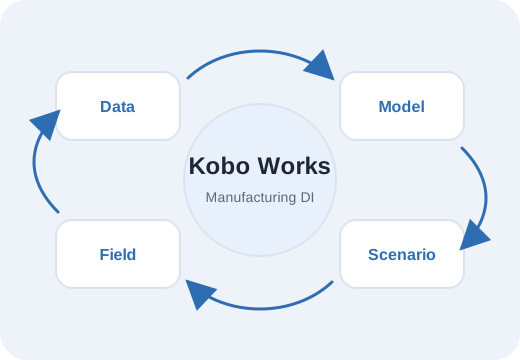
Surikobo's manufacturing DI handles complex decision-making related to the manufacturing floor and management decisions, This is a service that supports data analysis, simulation, mathematical optimization, and AI. And Surikobo's products that realize manufacturing DI in practical applications Kobo Works That's right.
Manufacturing faces many daily decisions such as production planning, inventory, quality, equipment, personnel, and demand fluctuations. However, in real-world operations, even if data exists, it may not be fully utilized, Sometimes, judgment depends heavily on experience and intuition.
Surikobo visualizes these on-site decision-making processes and builds systems to lead to more satisfactory decisions. Kobo Works serves as the implementation foundation to keep these systems embedded in daily operations.
What is Manufacturing DI?
DI stands for Decision Intelligence.
It's not just about visualizing data, "Which option should I choose?" "What will happen when conditions change?" "What is a better plan within constraints?" This is a system for supporting decision-making.
In manufacturing DI, we combine on-site data, business knowledge, and mathematical models, We aim to improve the quality of decision-making in manufacturing.
Kobo Works is a product that shapes this manufacturing DI concept on-site through screens, estimates, reports, and operational workflows that can be checked on-site. We connect mathematical models and AI not just as analysis results, but into a state that those responsible can use for the next decision.
Target Issues
Surikobo's manufacturing DI addresses challenges such as, for example, the following:
How should production planning be constructed?
How much inventory should you have?
Which measures should be chosen in response to demand fluctuations?
Where is the bottleneck in the process?
How should equipment and personnel be allocated?
How to identify factors of quality and defects
Want to consider future risks through simulation
There is data, but it is not fully utilized in decision-making.
The value provided by Surikobo
1. Organize On-Site Judgments Using Mathematical Models
Decision-making in manufacturing cannot be determined by simple numerical comparisons alone. Multiple factors such as delivery schedules, costs, quality, equipment constraints, staffing constraints, and inventory risks are intricately intertwined. At Surikobo, we organize these operational constraints and criteria and clarify the decision-making structure by translating them into analysis, simulation, and optimization.
2. Verify "what if" with simulation
There are various uncertainties on site, such as increased demand, equipment shutdowns, staff shortages, or changes in inventory standards. By leveraging simulation, multiple scenarios can be compared before actually implementing a measure.
3. Explore better options through optimization
Mathematical optimization is effective for making better plans within limited equipment, personnel, time, and costs. We build mechanisms to explore realistic solutions to problems with many constraints, such as production order, dispatch, inventory replenishment, work allocation, and equipment operation planning.
4. Connecting Data Analysis and AI to On-Site Decision-Making
AI and machine learning are not simply introduced as the goal. What matters is how you can use it to inform decision-making on the ground and in management. At Surikobo, we design processes such as demand forecasting, anomaly detection, quality analysis, and factor analysis in a way that connects them to actual decision-making.
Suitable for such companies
Companies that want to break away from relying on individual decisions at the manufacturing site
Companies that want to make greater use of Excel and existing system data
Companies experiencing challenges in production planning and inventory determination
Companies that want to incorporate simulation and optimization into their operations
Companies considering AI adoption but unsure about specific ways to utilize it
Companies that want to conduct small-scale verification before large-scale system deployment
How to proceed
Step 1. Organizing Business Issues
First, organize your current business flow, the data you use, your criteria for decision-making, and your constraints. At this stage, instead of creating a system right away, clarify "what you want to decide."
Step 2. Review of data and decision-making structures
Review available data and the decisions actually being made on site. If necessary, perform simple analyses and visualizations to understand the structure of the issues.
Step 3. Prototyping
On a small scale, you create prototypes for analysis, simulation, and optimization. Rather than building a large-scale system from scratch, check early on whether it will help with decision-making.
Step 4. Application to Business Operations
Once the effectiveness is confirmed, we organize it into a format that can be used in actual operations. If necessary, consider turning them into web applications, creating dashboards, or integrating with existing systems.
Features of Surikobo
Surikobo offers more than just AI implementation or dashboard creation, Focus on "decision-making itself" in manufacturing.
Combining data analysis, mathematical optimization, simulation, and system development, We design and implement decision-making support systems that can be used in the field. At the heart of this effort is Kobo Works.
Starting small, we verify in a way that fits the field, and through Kobo Works, we support the creation of systems rooted in practical work.
Please feel free to consult with us first.
Contact
If you have challenges related to manufacturing decision-making, such as production planning, inventory, quality, equipment, personnel, or demand forecasting, please feel free to consult us.
/ Data exists but is not being utilized
/ Want to know if AI and optimization can be used
/ Want to systematize on-site decision-making a bit more
/ Want to conduct small-scale tests with Kobo Works before considering implementation
Surikobo provides practical decision support that connects manufacturing sites with management, together with Kobo Works.